Back
to index Triosonic | Back
to "About Triosonic"
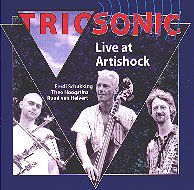
"Live at Artishock".
Recorded Live in Artishock Theatre, Soest, 14 June, 1997.
Ferdi
Schukking (saxophones), Theo
Hoogstins (double bass),
Ruud
van Helvert (drums)
(a red
ear-icon means that a sample of that piece can be downloaded, but therefore
you need a RealAudio player)
-
 Visserstraat
Blues (Fisherstreet Blues) is a blueslick played by the bass,
which evolves into a 3/4 time. During the improvisation, the 3/4 time can
be played at any given spot. The 14 bar structure turns the fours with
the drums into an exciting climax. Visserstraat
Blues (Fisherstreet Blues) is a blueslick played by the bass,
which evolves into a 3/4 time. During the improvisation, the 3/4 time can
be played at any given spot. The 14 bar structure turns the fours with
the drums into an exciting climax.
-
444
& 453 is a ballad with the melody consisting of all twelve
tones. The numbers refer to the use of complementary tetrachords, which
are comparable to the harmolodics of Ornette Coleman. The 453 stands for
a tetrachord, a pentachord and a very surprising e-minor triad at the end
of the theme.
-
Multiphonics/Vogelvlucht.
One can play multiphonics on a saxophone too. With certain grip combinations
and an extremely flexible embouchure, even chords can be brought to sound.
Multiphonics is being played on the soprano saxophone; quietly, chromatic,
modulating, and further back in the beginning. Then, more violent, with
dissonants, shrill-and-high further on. Vogelvlucht-(Bird's-eye View),
the second part, suggests additional tones by the rapid arpeggio movement.
The "circular-breathing-technique" also amplifies this effect.
-
7th Hour Blues.
By projecting a twelvetone series, based on the "seventh hour" of Peter
Schat's Tone Clock ©, on a minor blues, an unusual melody occurs,
with only the last tone defining the key. The baritone saxophone and the
bass alternate the solo, and accompany the drum solo with rhythmic background
patterns.
-
Wind in Rockanje
originated during a performance at the Dutch seaside resort of Rockanje.
The murmur of the sea is heard in the false air of the tenor saxophone.
The water coarses through the two chords of the bass, suggesting a gathering
storm.
-
Octocon (Octotonic
construction) is a composition based on two octotonic scales which are
worked up into series according to the applications of Arnold Schoenberg.
By harmonising these into two dominant seventh chords, a fanciful reference
to the blues occurs.
-
Spiral Sequence
is a twelve-tone series, which, because of rhythmic variation, takes on
a different character each time it is repeated. The series played in reverse
order introduce the solos, and the improvisations are based on the series
and the variations.
-
0 Amor Natural is a composition inspired by Hedy Honingmann's
Dutch television documentary about the Brazilian poet Carlos Drummond de
Andrade (1902-1987), who began writing erotic poetry in his late years.
In the documentary, the poems are recited by contemporaries of the same
age as de Andrade, and afterwards the readers are encouraged to interact
with the text they have just read. This results in an overview of the age
of lovemaking, with all its humour, tenderness, and deeply intimate and
touching moments, but also with a certain capriciousness and heedlessness
of the human existence. All of these elements are discernible in the composition.
The ongoing 6/8 movement, the lyrical melody, and with fervent improvisations.
-
Klipzo is a lively melody, based on the Caribbean Calypso.
In the bridge the theme is being played half-a-tone higher and shifted
one beat (the beat is reversed). And the count is seven bars instead of
eight.
|